Showing posts with label 24-24-24. Show all posts

Saturday, November 28, 2009

Foodbuzz 24, 24, 24: O Ya: Haute Japanese Cuisine

Some people in life simply eat to live. Others live to eat. Diners at O Ya definitely fit the latter category. Nestled into a former fire station, this Japanese gem has shook up the dining scene in Boston. Frank Bruni's reviewed O Ya as the NYTimes's 2008 Best New Restaurant in the United States, quite an accomplishment for a charming, unassuming restaurant in Boston's Leather District. We arrived for our 9pm reservation a few minutes tardy and were promptly shown to our seats at the chefs' counter.

Like any good foodie, I had spent a few hours pouring over O Ya's menu, as well as reviews on Yelp, Citysearch and numerous publications. Ordering your courses is a significant investment; each course costs between $8 and $38-thus, not a decision to be taken lightly.

The menu is divided up into user-friendly categories; nigiri, sashimi, vegetable, pork, wagyu beef, poulet rouge chicken, truffles & eggs, other stuff, something crunchy in it, salad and soup. Although I would have loved to get items from each category, I couldn't bring myself to order soup&salad at such an inventive place.

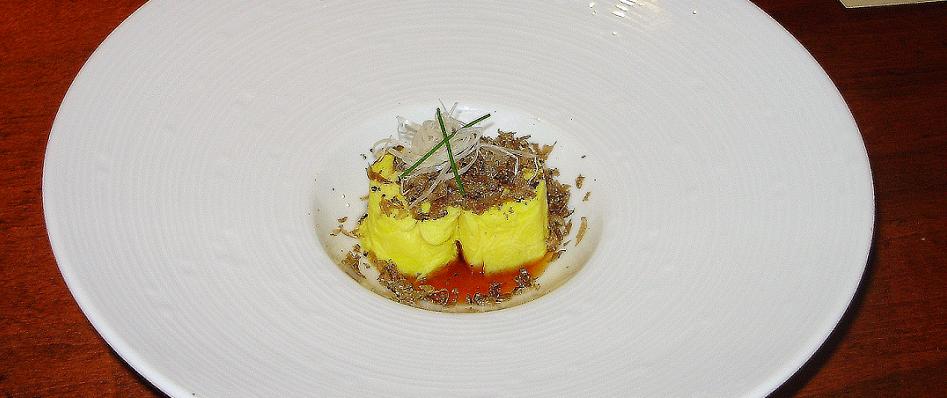
Tamago Omelet Roll with Dashi Sauce, Burgundy Truffles, Robiola and Chives


Tamago is a sweet egg omelet. Here, chefs at O Ya prepare it with burgundy truffles, a light and delicate truffle. They are typically served raw and shaved over dishes as a finishing garnish. Dashi is a broth made from bonito flakes-a deep cold water fish, usually skip jack tuna. Robiola cheese is soft, creamy and aromatic. The tamago was a sweet, earthy bite with a savory aftertaste left in your mouth from the dashi.

Shrimp Tempura with a Bacon-Truffle Emulsion, Chive Oil


Tempura is deep fried vegetable or seafood, which is commonly eaten in Japan. An emulsion of truffle and bacon is made by mixing two substances that normally would not go together, such as fat and water, and mixed together until they become viscous, forming an emulsion. The tempura were perfectly crunchy upon biting into them, the bacon-truffle emulsion was delicious-I could eat an entire platter of the tempura, sadly, 2 shrimp were all I experienced.


Peruvian-Style Toro Tuna Tataki with an Aji Panca Sauce and Cilantro Pesto


Toro is an incredibly tender cut from the tuna's belly. In tataki, the outside of the fish is seared (in our case, with a creme brulee torch) for just a few seconds. Aji is a hot chili pepper from Peru. The aji panca sauce was smoky but unfortunately overpowered the fish.


Tea-Brined Fried Pork Ribs with
Hot Sesame Oil, Honey, Scallions
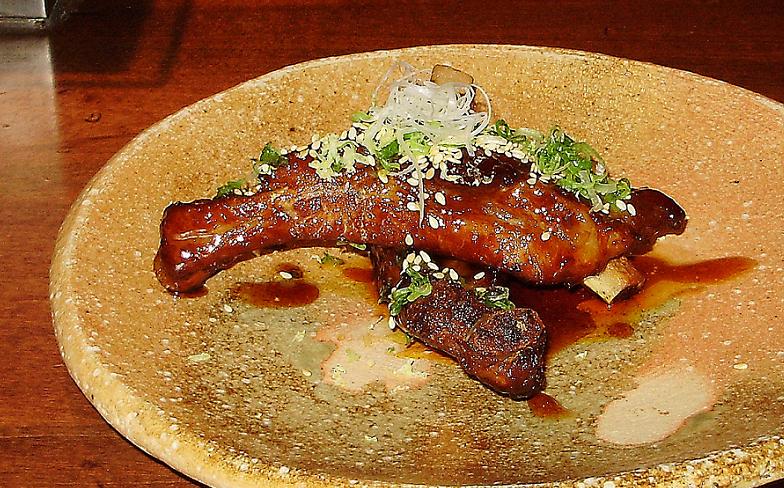

The chefs at O YA first brine these ribs in tea, then fry them, resulting in tender, moist and succulent bit of heaven. With a gentle poke of a chopstick the rib meat fell off the bone. Honey enhances the sweetness of the pork fat and spicy sesame oil complements the meat's richness. This was by far my favorite dish of the night. I could have eaten this meat candy all night long. I think my boyfriend caught my longing gazes (at the ribs, not him!) and offered me up some of his...good boyfriend!


Fried Kumamoto Oysters with Yuzu Kosho Aioli and Squid Ink Bubbles


I have gone through most of my life thinking that I didn't like oysters. Big mistake-turns out, I love fried oysters. The Kumamoto oyster tasted mildly fruity, has a rich, buttery texture and a slight mineral finish. A squid ink foam bubble covered the oyster; below was yuzu kosho-a combination of yuzu, a sour Japanese citrus fruit, and red or green chili peppers and salt, all over nori-wrapped sushi rice. It was a playful bite of crunchy, sweet and salty oyster, foamy squid ink and sour-spicy sauce. It was the kind of bite that makes you go, hmmm, afterwards while your brain deconstructs what just happened.


House Smoked Wagyu with Yuzu Soy


Wagyu refers to several breeds of cattle that are genetically predisposed to yummy-ness-that is, to intense marbling and a high percentage of unsaturated fat (some would argue that actually makes it healthier for you than a typical piece o' meat). It has enhanced tenderness, flavor and juiciness. The smoky beef was velvety, it melted in my mouth like a foie gras. The yuzu soy cut through the fattiness with just a hint of sour. I would definitely come back and try the other wagyu offerings-such as their petit loin with potato confit, sea salt and truffle oil, mmm...

Venison Tataki with Porcini Crema and Ponzu Oil

Venison was thinly sliced and briefly torched, then drizzled with ponzu oil, porcini crema and topped off with microgreens. Ponzu is a sour sauce made of Japanese citrus, soy sauce, vinegar, mirin and dashi. The venison's flavor was mild-not gamey at all, which was my fear, and tender. I felt somewhat underwhelmed, having mentally prepared for a strong flavor; I think that a second try would leave me with a more definitive decision about this dish.


Kyoto Style Enoki Mushrooms with Garlic and Soy


Enoki mushrooms have a mild, delightful flavor and a crunchy texture...and they remind me of spaghetti...or possibly a cute little cuttlefish (now picture a cuttlefish swimming through the ocean....adorable, isn't it?)

Wild Bluefin Maguro Tuna with Soy Braised Garlic and Micro Greens


A mature bluefin tuna can outweigh a pony! That, I certainly did not know before some research. At O Ya, micro is huge. I saw on numerous plates the smallest possible version of a salad I can think of atop various nigiri and sashimi dishes. Supposedly they are much more intensely flavored than normal salad greens-plus they fit much better atop sashimi ;)

Shrimp Sashimi with Golden Caviar...I think!


I didn't eat this dish-it appeared as we were waiting for our last dish, but my what a beauty! I was blown away by the intricate presentation of the dishes at O Ya-every morsel deliberated placed for maximum flavor and visual appeal. Golden caviar garnishes what I believe to be shrimp...anyone out there want to venture a guess at to this little fella's origin?

An hour and a half later, as we finished our meal, not a single table had left, nor had they attempted to acquire their checks. They seemed completely won over by O Ya. After some serious thought, I would declare that I too could fall in love with these small bites with big taste...if I could somehow find a sugar daddy or otherwise wealthy benefactor to pay for the bill (O Ya...oh boy, you are pricey!).

Sunday, May 31, 2009

Foodbuzz 24, 24, 24: One If On Land, Two If In The Sea; Eating My Way Up The Food Chain in Boston

My first introduction to seafood was working as a waitress in Faneuil Hall. I was 20, a vegetarian, and slightly traumatized by the experience of eating anything with tentacles-i thought they belonged in scary stories, definitely NOT in my stomach! However, upon eating fried calamari with spicy peppers and a lemon garlic aioli, I was surprised to find that I in fact loved the flavor (although, to be honest, you can fry just about anything, and I will think it tastes yummy). 6 years has passed since then, and I will eat all creatures, great and small : )

For my Foodbuzz 24-24-24 May event, I decided to eat my way up the food chain in Boston, stopping at historical as well as contemporary seafood restaurants. All sea creatures rely on other sea creatures for food to survive. At the bottom of the food chain are the sea plants and plankton. Many types of fish and animals such as the snail, shrimp, jellyfish, and sea star eat the plankton. The small animals and fish who eat plankton then become food for larger crustaceans, such as lobster or fish such as tuna or mackeral. Octopus prey on lobster (try searching for these oceanic show-downs on you-tube, it is great fun, I promise you!) These fish are then eaten by larger fish and animals, such as the shark and dolphin.

I set out upon this odyssey with my boyfriend. Our first stop was Skipjack's Seafood Restaurant located near the Copley Church. We shared a sesame-seaweed salad with salmon roe. I had a Sapporo-a delicious if not extremely large Japanese beer.


Haymarket occurs every Friday and Saturday between Faneuil Hall and the North End, Boston's Little Italy. For 1 dollar, you could purchase clams on the half shell in the market. Fresh vegetables, fruits, seafood and meats can be found for great prices. I am a bit of a wimp when it comes to eating raw fish...more so when it's sold on the street, but others were slurping away, enjoying their clams and then tossing the shells into a bucket next to the stand.


Our next stop was at Union Oyster House, America's oldest restaurant. It opened in 1826 and served many famous Bostonians, such as Daniel Webster, as stated in the sign below.


Our seafood platter was comprised of oysters, shrimp and clams, slightly higher on the totem pole than roe and seaweed. Horseradish, lemon and cocktail sauce were served alongside. Sitting at the oyster bar is a very no-nonsense experience, full of the famous Boston charm...I say this with a wry grin. Bostonians are known for being less-than-friendly, but once you get to know them, most are incredibly generous-you just have to get through the tough, protective exterior (much like the oysters our servers were shucking) before you can truly appreciate their personalities.


For local oyster lovers, the ninth annual Wellfleet OysterFest takes place the weekend after Columbus Day in Wellfleet, Cape Cod, Mass. This two-day street party celebrates the town's famous oysters, clams and shellfishing traditions and brings together locals and visitors alike for a weekend full of hometown flavor and big time fun. More information can be found at:


Our next stop was at Ned Devine's, an Irish restaurant in Faneuil Hall. Ned Devine's serves consistently good pub fare and local seafood. We shared a lobster roll BLT...it was my first lobster salad (I am ashamed to say) and is a classic Boston sandwich, chunks of lobster meat, mayo, perhaps some mustard or lemon. Served with lettuce, tomato and crispy bacon kicked it up a notch, adding texture and flavor.


Our last stop was at Tapeo Restaurant, a Spanish tapas spot on Newbury Street. There we ordered octopus, served in a fiery paprika and olive oil sauce. Although it appears small on the plate, the octopus can take out more sea creatures that it'd care to admit (if it could speak). On the plate, the meat was tender, not chewy and a light ending to our many meals.


At the top of the seafood chain is the shark. And who eats the shark? Apparently not us that night! Try as we might, shark evaded us that evening. Perhaps due to overfishing, perhaps due to its intelligence and fierce teeth, we may never know the reason that shark was lacking on every menu Saturday night. Having had mako shark in Chile, I assure you, it is delicious! And, really, I have no qualms about eating any creature that also could make a meal out of me. Look out sharks! Next time you shall not be so lucky. Rather you will be sauteed and served with a lovely sauce, perhaps a spicy razor clam sauce, a la Santiago. I will find you, and I will eat you.


Sunday, March 29, 2009

Foodbuzz 24, 24, 24: Hunting Steak in Argentina: Una Noche a la Parrilla

Argentina has the highest meat consumption per capita in the world. Above all other meats, beef is king in Argentina. The cows feed upon nutrient rich grass, resulting in healthy, essentially "free-range" cows. In Buenos Aires, a "parrilla", or steakhouse is as common as a Starbucks in the United States.


I arrived in Buenos Aires having made only one plan: to eat my first meal at an authentic Argentine parrilla. I try to avoid tourist traps and the most expensive restaurants when I travel. Thus, after much internet research, I decided that Rachael (a friend also visiting Buenos Aires) and I would eat at El Obrero, a restaurant in La Boca.

Now, people who say that Buenos Aires is the Paris of South America are probably not referring to La Boca, a run-down, tough neighborhood founded heavily by Italian immigrants. Very poor, many immigrants constructed their homes out of sheet metal. It is said that, as they could not afford to buy paintings to decorate their homes, they decided to paint their homes in bright colors in an attempt to make the neighborhood more attractive.

La Boca is not a place to wander off the beaten path, and, as such, Rachael and I arrived by taxi to El Obrero.


To use the bathroom, one must exit the back of the restaurant where you pass salad greens and mussels stored in buckets in the back of the restaurant. Chorizo and garlic hung outside the bathroom door (in a separate outdoor room, women were preparing food). Seeing the storage conditions, I am really glad that we did not decide to order mussels..


The inside of the restaurant was an homage to futbol (soccer). La Boca's pride and joy are the Boca Juniors, whose stadium stands a few blocks from the restaurant.

Blackboards listed appetizers, salads, meats, wines and desserts.


We started with a roasted eggplant appetizer. It had smoky taste and was marinated in vinegar and olive oil.


We also ordered "provoleta," baked provolone cheese garnished with herbs. Most Argentine restaurants have varying degrees of influence from Italian cuisine. Our restaurant was a blend of Spanish and Italian cuisines, with pure Argentine beef.


Giant slabs of beef lay on a cutting board in the open kitchen. The waiters took turns cutting and tending to the beef as it cooked. Only men worked the grill and as waiters-common in most Argentine restaurants. Perhaps a bit of machismo in the workplace?


Our waiter was from La Boca and had been working at El Obrero for over 10 years. His favorite steak is Bife de Chorizo, which is a juicy but lean cut, similar to our Porterhouse.


We decided to order 3 cuts of meat: bife de ojo (an eye filet, or ribeye), tira de asado (a rib roast) and bife de chorizo (the porterhouse). We ordered our steaks "a punto," which means medium rare. Unlike Europeans, Argentineans prefer their steak more well-done.


The steaks' arrival was a wonderful moment for us, as evidenced by our inappropriate joy. It took all of our self-constraint to photograph the steaks before slicing and devouring the beef.


Above is the bife de chorizo. Below is the eye filet.


The rib roast, or tira de asado, appeared juicy, but the effort it took to remove the meat from the bone almost negated the joy of eating it...that being said, the process did not take much effort. Supposedly tira de asado is one of the most popular cuts, but I did not find it memorable at all.


The eye filet, below, and the porterhouse were, in contrast, thick and juicy. They had the ability to both be a teeny bit chewy but then melt apart in your mouth seconds later.


Argentine steak is prepared with only salt and pepper. To marinade the steaks would ruin the omega-3, grass fed cows' unique flavor. That being said, chimichurri is a most popular accompaniment. The sauce is typically made with olive oil, garlic, parsley, bell pepper and vinegar, but there are as many variations as Argentine grandmothers, so each restaurant has its own recipe.


Some close ups of the cut eye filet-notice how juicy it is, even after being cooked past medium-rare.


While eating our meal, we were interrupted by several argentinos. The baby boy Alvaro was the most friendly. He continually visited us to try to give us a spoon, or take Rachael's camera, or just stare up with a goofy look on his cute little face.

The table next to us comes to El Obrero every Saturday. Why? The man on the left's reason: "porque Mario paga," because his friend to the right, Mario, pays for the food. In all seriousness, when the group entered they were greeted by name by the entire wait staff . That seemed to be a common theme during our 3 hour meal. While the steak was excellent, I suspect that there are better parrillas and better steak, but the lively atmosphere and neighborhood feel of the restaurant made us comfortable. The men at Mario's table asked us many questions about our plans for our time in Buenos Aires and offered suggestions, as well as a ride back to our hotel. We accepted the suggestions but definitely declined the ride!


For dessert we split "pave de dulce de leche," a moist dulce de leche cake topped with whipped cream. It reminded me a lot of "pastel de tres leches," a cake soaked in sweetened condensed milk. It was so delicious. We ordered coffee as well. Cortados, tall espresso shots with a little steamed milk. The perfect end to a mostly perfect meal.


Later that night, at a hotel lounge, we randomly met one of the more bizarre people I have met in my lifetime, the guitarist (I believe) from the 80s group Iron Maiden. Completely unrelated to steak, but still, kind of cool! : )


Later this week I will post about our empanada-eating Odyssey...stay tuned!